Showing posts with label diamond. Show all posts

Diamond Buying Guide

Diamond engagement rings and fine jewelry, loose diamonds, engagement rings, proposal, wedding rings.

Diamond Buying Guide
Before you start diamond shopping, you want to have an understanding of what you're buying. This guide simplifies the four Cs of diamonds - cut, color, clarity, and carat weight, so you can select your diamond based on the same criteria jewelers use to grade them.

Cut
The cut of a diamond has the most effect on its sparkle, or brilliance. Even if the diamond has perfect color and clarity, a poor cut can make a diamond look dull. Blue Nile carries only the highest grades of diamond cut, for the most sparkle. Learn how to choose the right diamond cut with the most brilliance for your budget.

Color
Diamonds with very little color are the most highly valued and are priced accordingly. A little color can diminish a diamond's brilliance. To help you choose the most brilliant diamond, Blue Nile offers diamonds with the highest grades of color. Learn how to choose a diamond with no color noticeable to the unaided eye.

Carat Weight
The weight of a diamond is measured in carats. Since larger diamonds are more rare than smaller diamonds, diamond value tends to rise exponentially with carat weight. Read more about carat weight and learn how to balance diamond quality with the size of your diamond.

Certification
The most important step in choosing a diamond is reviewing the diamond certificate, referred to by diamond grading labs as a grading report. A grading report documents the characteristics of a diamond, like the four Cs. Before purchasing a diamond, review a copy of its grading report, as this is proof that it has undergone an unbiased, professional examination. Learn more about the diamond grading report

The Brilliant diamond Cut

A brilliant is a diamond or other gemstone, cut in a particular form with numerous facets so as to have especial brilliancy. The shape resembles that of a cone and is meant to maximize light return through the top of the diamond.
Even with modern techniques, the cutting and polishing of a diamond crystal always results in a dramatic loss of weight; rarely is it less than 50%. The round brilliant cut is preferred when the crystal is an octahedron, as often two stones may be cut from one such crystal. Oddly shaped crystals such as macles are more likely to be cut in a fancy cut—that is, a cut other than the round brilliant—which the particular crystal shape lends itself to.
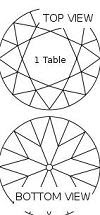
The modern round brilliant consists of 58 facets (or 57 if the culet is excluded), ordinarily today cut in two pyramids placed base to base: 33 on the crown (the top half above the middle or girdle of the stone), truncated comparatively near its base by the table, and 25 on the pavilion (the lower half below the girdle), which has only the apex cut off to form the culet, around which 8 extra facets are sometimes added. In recent decades, most girdles are faceted. Many girdles have 32, 64, 80, or 96 facets; these facets are not counted in the total. While the facet count is standard, the actual proportions (crown height and angle, pavilion depth, etc.) are not universally agreed upon.

The diamond cuts

"New diamond cuts are now all the rage in the diamond industry as for example a design invented in 2003 and called the Genesis cut. This cut differs in shape from the more traditional cuts in its concave surfaces and angles and resembles a 4-pointed star"
Diamond cutting is the art and science of creating a gem-quality diamond out of mined rough. The cut of a diamond describes the manner in which a diamond has been shaped and polished from its beginning form as a rough stone to its final gem proportions. The cut of a diamond describes the quality of workmanship and the angles to which a diamond is cut. Often diamond cut is confused with "shape".

There are mathematical guidelines for the angles and length ratios at which the diamond is supposed to be cut in order to reflect the maximum amount of light. Round brilliant diamonds, the most common, are guided by these specific guidelines, though fancy cut stones are not able to be as accurately guided by mathematical specifics.

The techniques for cutting diamonds have been developed over hundreds of years, with perhaps the greatest achievements made in 1919 by mathematician and gem enthusiast Marcel Tolkowsky. He developed the round brilliant cut by calculating the ideal shape to return and scatter light when a diamond is viewed from above. The modern round brilliant has 57 facets (polished faces), counting 33 on the crown (the top half), and 24 on the pavilion (the lower half). The girdle is the thin middle part. The function of the crown is to diffuse light into various colors and the pavilion's function to reflect light back through the top of the diamond.
Tolkowsky defined the ideal dimensions as:
Table percentage (table diameter divided by overall diameter) = 53%
Depth percentage (Overall depth divided by the overall diameter) = 59.3%
Pavilion Angle (Angle between the girdle and the pavilion) = 40.75°
Crown Angle (Angle between the girdle and the crown) = 34.5°
Pavilion Depth (Depth of pavilion divided by overall diameter) = 43.1%
Crown Depth (Depth of crown divided by crown diameter) = 16.2%
The culet is the tiny point or facet at the bottom of the diamond. This should be a negligible diameter, otherwise light leaks out of the bottom. Tolkowsky's ideal dimensions did not include a culet. However, a thin culet is required in reality in order to prevent the diamond from easily chipping in the setting. A normal culet should be about 1%–2% of the overall diameter.
The further the diamond's characteristics are from Tolkowsky's ideal, the less light will be reflected. However, there is a small range in which the diamond can be considered "ideal." Today, because of the relative importance of carat weight in society, many diamonds are often intentionally cut poorly to increase carat weight. There is a financial premium for a diamond that weighs the magical 1.0 carat (200 mg), so often the girdle is made thicker or the depth is increased. Neither of these tactics make the diamond appear any larger, and both greatly reduce the sparkle of the diamond. So a poorly cut 1.0 carat (200 mg) diamond may have the same diameter and appear as large as a 0.85 carats (170 mg) diamond. The depth percentage is the overall quickest indication of the quality of the cut of a round brilliant. "Ideal" round brilliant diamonds should not have a depth percentage greater than 62.5%. Another quick indication is the overall diameter. Typically a round brilliant 1.0 carat (200 mg) diamond should have a diameter of about 6.5 mm. Mathematically, the diameter in millimeters of a round brilliant should approximately equal 6.5 times the cube root of carat weight, or 11.1 times the cube root of gram weight, or 1.4 times the cube root of point weight.
Ideal cuts can be controversial as the definitions of brilliance and beauty are very subjective.
Tolkowsky's mathematical model is now superseded by the GIA Facetware software that is the culmination of 20 years of studies on diamond cuts
.

Value of colored diamonds

The Big Diamond : The Darya-I-Nur Diamond is one of the world's largest diamonds and is one of the most rare because of its pale pink color. It weighs about 182 carats (36.4 g). Its exact weight is unknown because its been mounted in its brooch setting for over 130 years. Its Persian name 'Darya-I-Nur' translates into English as the 'Sea of Light'.
Diamonds that enter the Gemological Institute of America's scale are valued according to their clarity and color. For example, a "D" or "E" rated diamond (both grades are considered colorless) is much more valuable than an "R" or "Y" rated diamond (light yellow or brown). This is due to two effects: high-color diamonds are rarer, limiting supply; and the bright white appearance of high-color diamonds is more desired by consumers, increasing demand. Poor color is usually not enough to eliminate the use of diamond as a gemstone: If other gemological characteristics of a stone are good, a low-color diamond can remain more valuable as a gem diamond than an industrial-use diamond, and can see use in diamond jewelry.
Diamonds that go out of scale in the rating are known as "fancy color" diamonds. Any light shade of diamond other than light yellow or light brown automatically falls out of the scale. For instance, a pale blue diamond won't get a "G" or "K" color grade, it will get a Faint Blue or Light Blue grade. These diamonds are valued using different criteria than those used for regular diamonds. When the color is rare, the more intensely colored a diamond is, the more valuable it becomes. Another factor that affect the value of Fancy-Colored diamonds is fashion trends, Pink diamond fetched higher prices after celebrity Jennifer Lopez was photographed wearing a square shaped pink diamond.
Fancy-colored diamonds such as the deep blue Hope Diamond are among the most valuable and sought-after diamonds in the world. In 2009 a 7 carat blue diamond fetched the highest price per-carat ever paid for a diamond when it was sold at auction for 10.5 million Swiss francs (US$9.5 million at the time) which is in excess of US$1.3 million per carat.
The Aurora Diamond Collection of natural color diamonds is one of the most comprehensive diamond collections in the world.

color of The Diamond

Diamonds (Possible colors) occur in a variety of colors — steel gray, white, blue, yellow, orange, red, green, pink to purple, brown, and black. Colored diamonds contain interstitial impurities or structural defects that cause the coloration, whilst pure diamonds are perfectly transparent and colorless. Diamonds are scientifically classed into two main types and several subtypes, according to the nature of impurities present and how these impurities affect light absorption:
Type I diamond has nitrogen (N) atoms as the main impurity, commonly at a concentration of 0.1 percent. If the N atoms are in pairs they do not affect the diamond's color; these are Type IaA. If the N atoms are in large even-numbered aggregates they impart a yellow to brown tint (Type IaB). About 98 percent[citation needed] of gem diamonds are type Ia, and most of these are a mixture of IaA and IaB material: these diamonds belong to the Cape series, named after the diamond-rich region formerly known as Cape Province in South Africa, whose deposits are largely Type Ia. If the N atoms are dispersed throughout the crystal in isolated sites (not paired or grouped), they give the stone an intense yellow or occasionally brown tint (Type Ib); the rare canary diamonds belong to this type, which represents only 0.1 percent of known natural diamonds. Synthetic diamond containing nitrogen is Type Ib. Type I diamonds absorb in both the infrared and ultraviolet region, from 320 nm. They also have a characteristic fluorescence and visible absorption spectrum (see Optical properties of diamond).
Type II diamonds have no measurable nitrogen impurities. Type II diamonds absorb in a different region of the infrared, and transmit in the ultraviolet below 225 nm, unlike Type I diamonds. They also have differing fluorescence characteristics, but no discernible visible absorption spectrum. Type IIa diamond can be colored pink, red, or brown due to structural anomalies arising through plastic deformation during crystal growth—these diamonds are rare (1.8 percent of gem diamonds), but constitute a large percentage of Australian production. Type IIb diamonds, which account for 0.1 percent of gem diamonds, are usually a steely blue or grey due to scattered boron within the crystal matrix; these diamonds are also semiconductors, unlike other diamond types (see Electrical properties of diamond). However, an overabundance of hydrogen can also impart a blue color; these are not necessarily Type IIb.
Also not restricted to type are green diamonds, whose color is derived from exposure to varying quantities of radiation.-wikipedia.org-

Diamond color

The most fine quality as per color grading is totally colorless which is Graded as "D" color diamond across the globe which means it is absolutely free from any color. The next is very slight traces of color which can be observed by any expert Diamond valuer/grading laboratory. However when studded in the jewelery these very light colored diamonds do not show any color or it is not possible to make out color shades. These are graded as E color or F color Diamonds. Diamonds which show very little traces of color are graded as G or H color diamonds. Slightly colored diamonds are graded as I or J or K color. A diamond can be found in any other color also other than colorless. Some of the color diamonds such as pink are very rare diamonds and are priceless.
The majority of diamonds that are mined are in a range of pale yellow or brown color that is termed the normal color range. Diamonds that are of intense yellow or brown, or any other color are called fancy color diamonds. Diamonds that are of the very highest purity are totally colorless, and appear a bright white. The degree to which diamonds exhibit body color is one of the four value factors by which diamonds are assessed.
History of color grading
Color grading of diamonds was performed as a step of sorting rough diamonds for sale by the London Diamond Syndicate.
As the diamond trade developed, early diamond grades were introduced by various parties in the diamond trade. Without any co-operative development these early grading systems lacked standard nomenclature, and consistency. Some early grading scales were; I, II, III; A, AA, AAA; A, B, C. Numerous terms developed to describe diamonds of particular colors: golconda, river, jagers, cape, blue white, fine white, and gem blue, "brown".

The Diamond Clarity grading

Diamond Grading systems by other organizations
The clarity grading system developed by the GIA has been used throughout the industry as well as by other diamond grading agencies including the American Gemological Society (AGS), European Gemological Laboratory (EGL), and the International Gemological Laboratory (IGL). These grading agencies base their clarity grades on the characteristics of inclusions visible to a trained professional when a diamond is viewed from above under 10x magnification.


Confédération Internationale de la Bijouterie, Joaillerie, Orfèvrerie des Diamants, Perles et Pierres (CIBJO).
The CIBJO or the International Confederation of Jewellery, Silverware, Diamonds and Stones developed the International Clarity Scale for grading diamonds. This clarity scale mirrors the GIA grading scale, except nomenclature varies. The CIBJO system names these clarity grades; Loupe Clean, Very, very small inclusions (VVS1 and VVS2), Very small inclusions (VS1 and VS2), Small inclusions (SI1 and SI2), Pique (P1, P2, and P3).
Clarity grading by CIBJO standards is by examination using a 10x achromatic, aplanatic loupe in normal light.


The IDC or the International Diamond Council uses a very similar standard to CIBJO. IDC loupe clean stones that have external blemishes have notations made on the grading report. IDC clarity grading is by examination using a 10x achromatic, aplanatic loupe in normal light.
The European Gemological Laboratory (EGL) introduced the SI3 as a clarity grade. While intended as a range to include borderline SI2 / I1 stones, it is now commonly used to mean I1's which are "eye clean", that is, which have inclusions which are not obviously visible to the naked eye.

Clarity grading considerations
All grades reflect the appearance to an experienced grader when viewed from above at 10x magnification, though higher magnifications and viewing from other angles are used during the grading process. The grader studies the diamond for internal characteristics, and judges them on the basis of five clarity factors; size, number, position, nature, and color or relief. The clarity grade is assessed on the basis of the most noticeable inclusions, otherwise called: grade setting inclusions. This means that less significant inclusions are ignored for the purposes of setting the grade. However, they may still be plotted onto a diamond plot chart. -Wikipedia.org-

Accurate clarity grading as with other grading steps must be done with the diamond loose; meaning not set into any mounting. Inclusions are often difficult to see from the crown side of the diamond, and may be concealed by the setting.
Size
The first clarity factor which is assessed is a clarity characteristic's size. Larger characteristics are typically more noticeable under magnification, thereby placing the diamond into a lower clarity grade.
Number
The second clarity factor which is assessed is the number of clarity characteristics. Generally the more characteristics the lower the clarity grade. This assessment is made by judging how readily they can be seen, not by the actual number of characteristics.
Position
The third clarity factor which is assessed is the characteristic's position. When an inclusion is directly under the table of the diamond it is most visible. An inclusion under the table and positioned close to a pavilion facet, will reflect multiple times around the stone, giving this type of inclusion the name reflector. Reflectors are graded as if each reflection were an inclusion (although in plotting the diamond it is only plotted once). For this reason reflectors have a greater impact on the clarity grade. Inclusions become less visible when they are positioned under the crown facets, or near the girdle of the stone. These inclusions may often be more easily seen from the pavilion side of the diamond than from crown side of the diamond.
In addition the position of large feathers, knots and included crystals positioned where they extend to the girdle or crown of the stone, affect the clarity grade. Diamonds worn in jewelry typically will withstand breakage, however inclusions of this nature, in these positions, can pose a risk for further extension of the break in the structure of the diamond. Inclusions that are judged to pose at least a moderate risk of breakage to the stone are graded in the included category.
Nature
The fourth clarity factor which is assessed is a characteristic's nature. The characteristic's nature determines whether it is internal where they extend into the stone, or external; where they are limited to the surface of the stone. Internal characteristics automatically exclude the diamond from the flawless, and internally flawless categories. External characteristics exclude the diamond from the flawless category.
A diamond's internal characteristics can be a; bruise, cavity, chip, cleavage, cloud, crystal, feather, grain center, indented natural, internal graining, knot, laser drill hole, needle, pinpoint, or twinning wisp.
A diamond's external characteristics can be an; abrasion, natural, nick, pit, polish lines, polish mark, scratch, surface graining, or extra facet.
The nature will also detail whether an inclusion poses a risk to the stone. Inclusions that cause or may cause a break in the crystal structure (included crystal, feather, knot, cleavage) are considered alongside their position, to assess whether they pose a moderate level of risk for further breakage.
Color or relief
The fifth clarity factor which is assessed is the color and relief of clarity characteristics. Characteristics that contrast with the surrounding diamond are said to have relief. The degree to which this color and relief is noticeable affects the clarity grade of the diamond. Colored inclusions invariably show contrast and are more easily seen. An exception is a black pinpoint inclusion which is often more difficult to see than a white pinpoint.

Diamond Clarity grading

Clarity is one of the four Cs of diamond grading, the others being carat, color, and cut. Diamonds with higher clarity grades are more valued, with the exceedingly rare "flawless" graded diamond fetching the highest price. Minor inclusions or blemishes are useful, as they can be used as unique identifying marks analogous to fingerprints.
The GIA grading system today
.

The GIA diamond grading scale is divided into six categories and eleven grades. The clarity categories and grades are:
Flawless category (FL) diamonds have no inclusions or blemishes visible under 10x magnification.
Internally Flawless category (IF) diamonds have no inclusions visible under 10x magnification, only small blemishes on the diamond surface.
Very, Very Slightly Included category (VVS) diamonds have minute inclusions that are difficult for a skilled grader to see under 10x magnification. The VVS category is divided into two grades; VVS1 denotes a higher clarity grade than VVS2. Pinpoints and needles set the grade at VVS.
Very Slightly Included category (VS) diamonds have minor inclusions that are difficult to somewhat easy for a trained grader to see when viewed under 10x magnification. The VS category is divided into two grades; VS1 denotes a higher clarity grade than VS2. Typically the inclusions in VS diamonds are invisible without magnification, however infrequently some VS2 inclusions may still be visible to the eye. An example would be on a large emerald cut diamond which has a small inclusion under the corner of the table.
Slightly Included category (SI) diamonds have noticeable inclusions that are easy to very easy for a trained grader to see when viewed under 10x magnification. The SI category is divided into two grades; SI1 denotes a higher clarity grade than SI2. These may or may not be noticeable to the naked eye.
Included category (I) diamonds have obvious inclusions that are clearly visible to a trained grader under 10x magnification. Included diamonds have inclusions that are usually visible without magnification or have inclusions that threaten the durability of the stone. The I category is divided into three grades; I1 denotes a higher clarity grade than I2, which in turn is higher than I3. Inclusions in I1 diamonds often are seen to the unaided eye. I2 inclusions are easily seen, while I3 diamonds have large and extremely easy to see inclusions that typically impact the brilliance of the diamond, as well as having inclusions that are often likely to threaten the structure of the diamond. -Wikipedia.org-

There are several types of inclusions and blemishes, which affect a diamond's clarity to varying degrees. Features resulting from diamond enhancement procedures, such as laser lines, are also considered inclusions and/or blemishes.
Inclusions
Clouds
Feathers
Included crystals or minerals
Knots
Cavities
Cleavage
Bearding
Internal graining

The diamond industry uses the term "internal characteristics" instead of "inclusions". For natural diamonds, the "internal characteristics" in the diamond are growth crystals that give the diamond its character and unique fingerprint. When diamonds are graded they are magnified at 10x power.
Blemishes
Polish lines
Grain boundaries
Naturals
Scratches
Nicks
Pits
Chips

Diamond - clarity

Diamond understanding-about-know:
Diamond clarity is a quality of diamonds relating to the existence and visual appearance of internal characteristics of a diamond called inclusions, and surface defects called blemishes. Clarity is a measure of internal defects of a diamond called inclusions. Inclusions may be crystals of a foreign material or another diamond crystal, or structural imperfections such as tiny cracks that can appear whitish or cloudy.
Clarity is one of the four Cs of diamond grading, the others being carat, color, and cut. Inclusions may be crystals of a foreign material or another diamond crystal, or structural imperfections such as tiny cracks that can appear whitish or cloudy. The number, size, color, relative location, orientation, and visibility of inclusions can all affect the relative clarity of a diamond. A clarity grade is assigned based on the overall appearance of the stone under 10x magnification.
Most inclusions present in gem-quality diamonds do not affect the diamonds' performance or structural integrity. However, large clouds can affect a diamond's ability to transmit and scatter light. Large cracks close to or breaking the surface may reduce a diamond's resistance to fracture.
Diamonds with higher clarity grades are more valued, with the exceedingly rare "flawless" graded diamond fetching the highest price. Minor inclusions or blemishes are useful, as they can be used as unique identifying marks analogous to fingerprints. In addition, as synthetic diamond technology improves and distinguishing between natural and synthetic diamonds becomes more difficult, inclusions or blemishes can be used as proof of natural origin.

Diamond - Carat

Understanding diamond
One of the characteristics of diamonds that make them so desirable as jewelry is their tendency to disperse white light into its component colors, giving the diamond its characteristic "fire." Diamonds are such a highly traded commodity that multiple organizations have been created for grading and certifying diamonds based on the four Cs which are carat, cut, color, and clarity. Other characteristics, such as shape and presence or lack of fluorescence also affect the desirability and thus the value of a diamond used for jewelry. Perhaps the most famous use of a diamond in jewelry is its use in engagement rings. This use became popular in the early to mid 1900's due to an advertisement campaign by the De Beers company, though diamond rings were used to symbolize engagements since at least the 15th century.
Diamond Carat:
The carat weight measures the mass of a diamond. One carat is defined as 200 milligrams (about 0.007 ounce avoirdupois). The point unit—equal to one one-hundredth of a carat (0.01 carat, or 2 mg)—is commonly used for diamonds of less than one carat. All else being equal, the price per carat increases with carat weight, since larger diamonds are both rarer and more desirable for use as gemstones.
The price per carat does not increase linearly with increasing size. Instead, there are sharp jumps around milestone carat weights, as demand is much higher for diamonds weighing just more than a milestone than for those weighing just less. As an example, a 0.95 carats (190 mg) diamond may have a significantly lower price per carat than a comparable 1.05 carats (210 mg) diamond, because of differences in demand.
Carat is not a measure of a diamond's size, since cutting a diamond to different proportions can affect its weight. (The word 'Karat' is used to express the purity of gold, and is not used in relation to diamonds.)
Here is a diagram that shows the relative size of various carat weights in a diamond that is cut to the same proportions: Note: the diamonds illustrated are not shown actual size .:

A weekly diamond price list, the Rapaport Diamond Report is published by Martin Rapaport, CEO of Rapaport Group of New York, for different diamond cuts, clarity and weights. It is currently considered the de-facto retail price baseline. Jewelers often trade diamonds at negotiated discounts off the Rapaport price (e.g., "R -3%").
In the wholesale trade of gem diamonds, carat is often used in denominating lots of diamonds for sale. For example, a buyer may place an order for 100 carats (20 g) of 0.5 carats (100 mg), D–F, VS2-SI1, excellent cut diamonds, indicating he wishes to purchase 200 diamonds (100 carats (20 g) total mass) of those approximate characteristics. Because of this, diamond prices (particularly among wholesalers and other industry professionals) are often quoted per carat, rather than per stone.
Total carat weight (t.c.w.) is a phrase used to describe the total mass of diamonds or other gemstone in a piece of jewelry, when more than one gemstone is used. Diamond solitaire earrings, for example, are usually quoted in t.c.w. when placed for sale, indicating the mass of the diamonds in both earrings and not each individual diamond. T.c.w. is also widely used for diamond necklaces, bracelets and other similar jewelry pieces.

The Diamond & jewels

about and knowing:
Diamonds have been known to mankind and used as decorative items since ancient times, The Diamond's hardness and high dispersion of light make it useful for industrial applications and jewelry.
The most familiar usage of diamonds today is as gemstones used for adornment a usage which dates back into antiquity. The dispersion of white light into spectral colors, is the primary gemological characteristic of gem diamonds. In the twentieth century, experts in the field of gemology have developed methods of grading diamonds and other gemstones based on the characteristics most important to their value as a gem. Four characteristics known informally as the four Cs are now commonly used as the basic descriptors of diamonds: carat, cut, color, and clarity.
Most gem diamonds are traded on the wholesale market based on single values for each of the four Cs; for example knowing that a diamond is rated as 1.5 carats (300 mg), VS2 clarity, F color, excellent cut round brilliant, is enough to reasonably establish an expected price range. More detailed information from within each characteristic is used to determine actual market value for individual stones. Consumers who purchase individual diamonds are often advised to use the four Cs to pick the diamond that is "right" for them.
Other characteristics also influence the value and appearance of a gem diamond. These include physical characteristics such as the presence of fluorescence as well as the diamond's source and which gemological institute evaluated the diamond. Cleanliness also dramatically affects a diamond's beauty.
There are three major non-profit gemological associations which grade and provide reports or certificates ("certs") on diamonds; while carat weight and cut angles are mathematically defined, the clarity and color are judged by the trained human eye and are therefore open to slight variance in interpretation. The associations are listed below.
- Gemological Institute of America (GIA) was the first laboratory in America to issue modern diamond reports, and is held in high regard amongst gemologists for its consistent, conservative grading.
- American Gem Society (AGS) is not as widely recognized nor as old as the GIA but garners a high reputation. The AGS employs a number system for grading cut quality, color grade, and clarity. The highest grade being '0', and the lowest being '10'.
- Diamond High Council (HRD) Official certification laboratory of the Belgian diamond industry, located in Antwerp. Antwerp World Diamond Center.
Within the last two decades, a number of for-profit gemological grading laboratories have also been established, many of them also based in Antwerp or New York. These entities serve to provide similar services as the non-profit associations above, but in a less expensive and more timely fashion. They produce certificates that are similar in detail to the GIA's.